
A Wholehearted guide to leading from the inside out
You may be carrying a vision for change.
A healthier team.
A stronger culture.
A deeper sense of ownership.
A more courageous organisation.
You may be giving yourself to something good, while quietly wondering why the atmosphere still feels tense, tired, or harder than it should.
The meetings keep happening.
The strategy keeps moving.
The responsibilities keep coming.
It leaves us with unanswered questions:
Why isn’t this landing the way I hoped?
Why does it feel heavier than it should?
Why doesn’t the culture shift, even when the intentions are right?
So we try to do more, fix more, push a little harder.
But somewhere beneath the surface, a quieter question begins to form:
What is being shaped in me while I am trying to shape this?
That question matters.
Because transformation around us often begins with transformation within us.
At Wholehearted Solutions, we believe leadership is never only about what a leader does. It is also about what a leader carries.
The heart of the leader does not stay hidden for long.
It becomes atmosphere.
It becomes tone.
It becomes culture.
It becomes the way people experience the work.
So, what is transformational leadership?
What Is Transformational Leadership?
Transformational leadership is often described as leadership that inspires people towards meaningful change.
It is the kind of leadership that helps people move beyond task completion and into vision, growth, ownership, and shared purpose.
That is true.
But through the Wholehearted lens, it is not complete.
Transformational leadership is not only about creating change around us. It is about becoming the kind of leader through whom healthy change can flow.
It does not only ask:
What are we building?
It also asks:
Who are we becoming as we build it?
That second question changes everything.
Because a leader can build something impressive and still leave people diminished.
A team can achieve the target and lose trust on the journey.
An organisation can grow externally while becoming weary, anxious, or disconnected internally.
Transformational leadership is concerned with more than outcomes.
It is concerned with people.
Not just what people produce.
Who they are becoming.
How they are growing.
What is happening in their hearts as they give themselves to the work.
The goal is not simply performance.
The goal is people becoming more whole.
Why Transformation Starts With the Leader
One of the uncomfortable truths of leadership is this:
You can only lead people where you are willing to go yourself.
If we want to cultivate honesty, courage, trust, and wholeness in others, we cannot avoid those places in ourselves.
Leadership is never merely functional.
It is deeply relational.
People do not only hear what a leader says. They feel what a leader carries.
They may not always be able to name it.
But they often sense it.
Anxiety has an atmosphere.
Hurry has an atmosphere.
Control has an atmosphere.
So does peace.
A hurried heart creates a restless culture.
An anxious heart creates pressure.
A controlling heart creates caution.
A divided heart creates disconnection.
People do not only follow what a leader says. They absorb what a leader carries.
That is why trying to appear strong rarely works for long.
A leader may look calm, capable, and in control. But if the inner world remains anxious, fearful, or unresolved, it will often show itself somewhere.
In impatience.
In defensiveness.
In overreaction.
In pressure placed on the team.
In the inability to trust.
The issue is not always technique.
Sometimes the deeper issue is the heart under pressure.
And when what is happening in the heart remains unprocessed, other people begin to experience it through our leadership.
Transformational leadership asks a deeper question:
Not only, “How do I lead others better?”
But:
What is happening within me that others are beginning to experience through me?
The Wholehearted Shape of Transformational Leadership
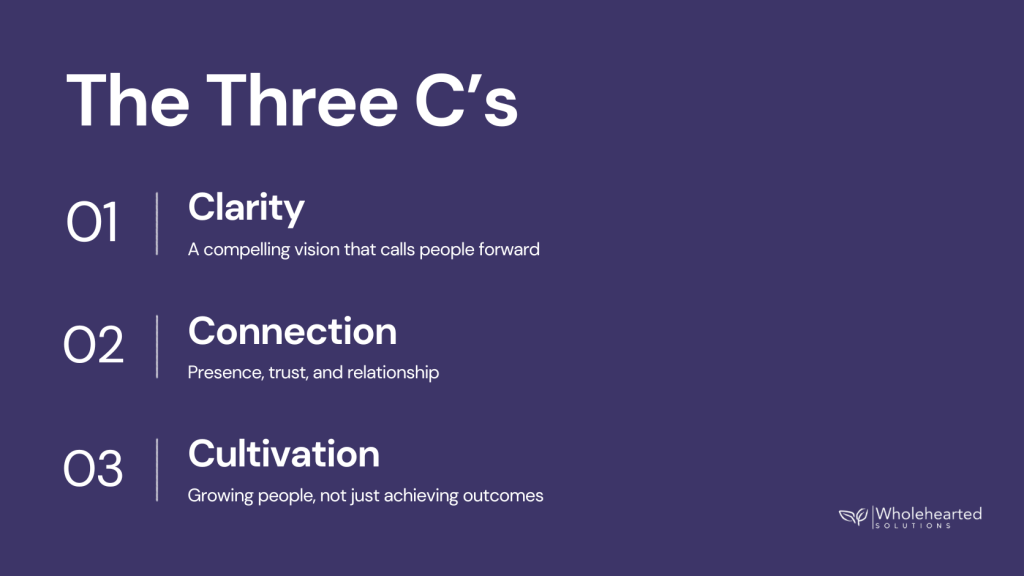
At Wholehearted, we often come back to three words:
Clarity.
Connection.
Cultivation.
Not as a formula.
As a way of paying attention.
Clarity
People need to know where they are going.
They need a vision that calls them forward. They need to understand why the work matters, what is being built, and how their contribution fits into the bigger picture.
Without clarity, people drift.
Teams become reactive.
Energy becomes scattered.
The work loses direction.
A transformational leader brings clarity.
Not harshness.
Not control.
Not pressure dressed up as urgency.
Clarity.
The kind that helps people lift their eyes and see what could be.
But clarity on its own is not enough.
A leader can have a compelling vision and still create a weary culture.
People can believe in the destination and still not have the heart to keep going.
Vision may point people forward, but connection gives them the heart to keep going.
Connection
Connection is more than communication.
It is more than clear updates, good meetings, or well-written strategy documents.
Connection is presence.
It is the willingness to see people, not just use them.
To understand what they carry.
To listen beneath the words.
To create trust.
People may comply with a vision from a distance.
But they commit when they feel seen.
This matters because relationship is not a soft extra in leadership.
Relationship is the currency of trust.
When people feel seen, valued, and understood, something opens up. They bring more of themselves. They contribute more honestly. They take more responsibility.
But when people feel unseen or used, even the best strategy starts to lose life.
Cultivation
Cultivation is one of the clearest marks of transformational leadership.
A divided leader often focuses on doing, driving, and demanding.
A wholehearted leader asks something deeper:
How are people being developed in the process?
That question changes how we lead.
Instead of asking only, “How do I get people to perform?” we begin to ask, “How do I help people grow?”
Instead of only managing tasks, we begin cultivating gifts, confidence, capacity, and contribution.
This is where tools like the MPACT assessment can be so helpful.
They give teams language for what is often felt but not yet spoken.
What each person brings.
Where pressure appears.
How people relate.
Where difference can become strength rather than tension.
The goal is not simply to manage people better.
The goal is to cultivate people within a shared life and purpose.
Why Behaviour Management Is Not Enough
Behaviour matters.
Standards matter.
Delivery matters.
Responsibility matters.
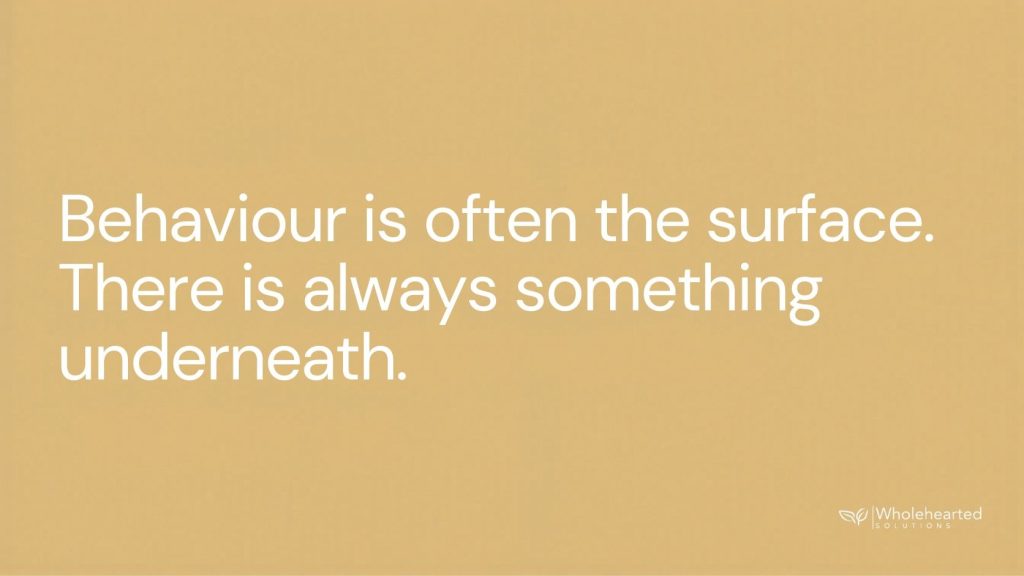
But behaviour is rarely the deepest story.
One of the dangers in leadership is that we become overly focused on outward behaviour.
We want people to do the right thing.
Meet the deadline.
Deliver the project.
Maintain the standard.
None of that is wrong.
But when behaviour becomes the only focus, leadership can quickly become command and control.
The leader becomes anxious to make sure everything is done properly.
So they tighten their grip.
On decisions.
On details.
On people.
On outcomes.
And sometimes, control can look very respectable.
It can look like responsibility.
It can look like excellence.
It can look like high standards.
But sometimes control is a fig leaf.
A covering for fear.
A covering for shame.
A covering for the quiet belief:
If I let go, everything will fall apart.
Control can look like excellence. But sometimes it is fear dressed as leadership.
This may work for a while.
Especially in a small team.
But as responsibility grows, control becomes exhausting. The more people involved, the more impossible it becomes to hold everything together by force of will.
Over time, people may still perform.
But they perform under pressure.
They may comply, but they do not take ownership.
They may get the work over the line, but trust is depleted on the journey.
And when trust is depleted, even apparent success begins to sabotage itself.
Transformational leadership does not ignore behaviour.
But it understands that behaviour is not the deepest issue.
Beneath every behaviour, there is often a feeling.
Beneath every feeling, there is often a need.
So the deeper question is not only:
How do we change the behaviour?
The deeper question is:
What is happening beneath it?
The Gap Between Head and Heart
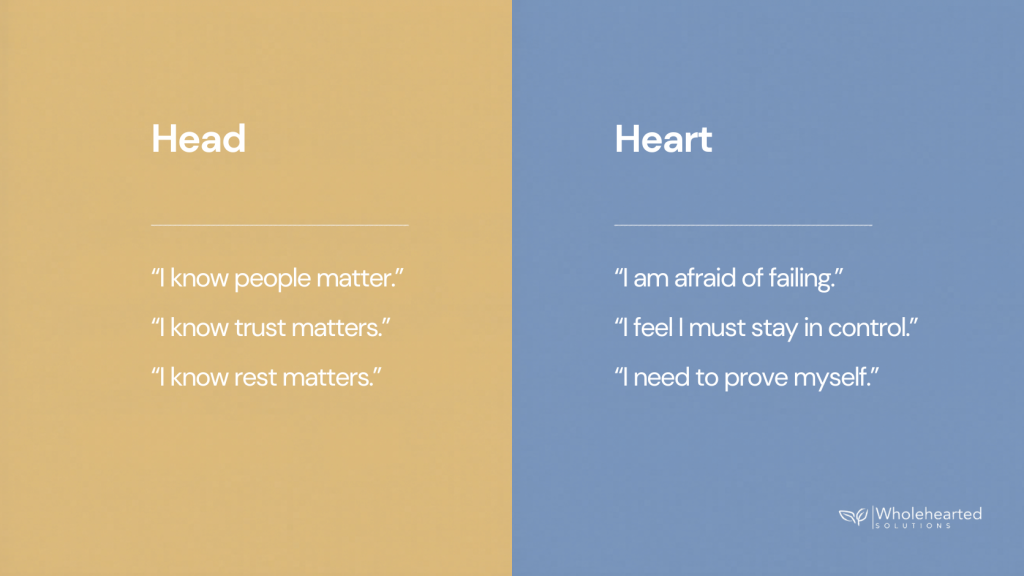
Many leaders know the right things in their heads.
They know people matter.
They know trust matters.
They know rest matters.
They know culture matters.
They know compassion matters.
But knowing something in the head is not the same as living it from the heart.
Our head may know:
I am capable.
But our heart may still fear:
I am not enough.
Our head may know:
I am loved.
But our heart may still feel:
I must perform to be accepted.
Our head may know:
I can trust others.
But our heart may still believe:
Everything will fall apart if I let go.
This is the chasm between head and heart.
And under pressure, that chasm often shows up in how we lead.
Many leaders know the right things in their heads, but lead from what their hearts still fear.
That is why transformational leadership is not just about learning better leadership tools.
Tools are helpful.
Frameworks are helpful.
Strategy is helpful.
But if the heart remains divided, the same patterns often return.
We may call it diligence, when it is really fear.
We may call it excellence, when it is really control.
We may call it responsibility, when it is really the inability to trust.
We may call it drive, when it is really the need to prove ourselves.
At Wholehearted, we often talk about naming the thing behind the thing.
The surface issue may be busyness.
But beneath the busyness may be fear.
Fear of failing.
Fear of being exposed.
Fear of not being enough.
Fear of disappointing people.
Fear of losing control.
Fear of being found out.
What remains unnamed does not remain neutral. It begins to lead us from underneath.
Becoming a Non-Anxious Presence
A transformational leader is not a perfect leader.
They are not untouched by pressure.
They do not become emotionless, detached, or endlessly calm.
But they are learning to become a non-anxious presence.
A non-anxious presence is not the absence of emotion. It is the presence of inner steadiness.
It is the presence of someone who is doing the inner work required to lead from a deeper place.
An anxious leader drives pressure.
A wholehearted leader creates space.
An anxious leader demands compliance.
A wholehearted leader cultivates ownership.
An anxious leader controls the system.
A wholehearted leader steadies the system.
This does not mean avoiding challenge.
Wholehearted leadership is not passive.
It can still bring clarity.
It can still make decisions.
It can still hold boundaries.
It can still name what needs to be named.
But it does so from a different place.
Not from panic.
Not from proving.
Not from fear.
Not from the need to control.
From steadiness.
And that steadiness changes the atmosphere.
It gives people room to think.
Room to contribute.
Room to be honest.
Room to grow.
This is why transformational leadership is not only about what happens in the organisation.
It is about what is being formed in the leader.
How to Begin: Pause, Perceive, Process
So where do we begin?
Not by trying harder.
Not by adding another leadership technique.
Not by performing a more impressive version of ourselves.
We begin by paying attention.
Pause
Pause long enough to hear your heart.
Many leaders move so quickly that they rarely notice what is happening beneath the surface.
The meeting ends.
The next one begins.
The decision is made.
The pressure moves on.
But the heart keeps speaking.
Through irritation.
Through tiredness.
Through disproportionate reactions.
Through the loss of joy.
Through the quiet sense that something is not well.
Pause asks:
What am I carrying right now?
What felt larger in me than the situation required?
What am I avoiding?
What is my heart trying to tell me?
Perceive
Perceive what is really going on beneath the reaction.
The first answer is not always the deepest answer.
“I am busy” may be true.
But what is beneath the busyness?
Fear?
Shame?
Loneliness?
The need to prove yourself?
The fear of being found out?
The belief that everything depends on you?
Perceiving is the work of noticing what is happening underneath.
Not with harshness.
With honesty.
Process
Process what surfaces until it loses its power.
It is one thing to notice what is there.
It is another to stay with it long enough for it to be transformed.
For Christian leaders, this may also become prayer.
Naming what is carried.
Bringing it before God.
Allowing grace and truth to meet what has been driving us from beneath the surface.
This is not quick work.
But it is freeing work.
Because what we are willing to face is what we are no longer ruled by.
A Final Reflection
Pause for a moment.
What atmosphere are people experiencing through your leadership?
Where are you bringing steadiness?
Where are you carrying pressure?
Where are you asking others to live with what you have not yet processed?
What might your heart be asking you to notice?
Transformational leadership does not begin with a strategy.
It begins with a leader willing to be transformed.
Ready to Lead From a Deeper Place?
There is another way to lead: not from pressure, performance, or proving — but from a deeper place.
At Wholehearted Solutions, we create safe, skilled spaces for leaders, teams, churches, and organisations to pay attention to what is happening beneath the surface, build the bridge between head and heart, and cultivate healthier cultures where people can flourish.