
When executive teams face deep friction, it is tempting to diagnose the issue as a “people problem.” We assume certain personalities are simply incompatible. Or we conclude the culture itself has become toxic. In either case, our attention is drawn to the symptoms rather than the underlying causes.
But through the Wholehearted lens, we often find something completely different. What feels like a relational clash is frequently a systemic, structural imbalance.
If you want to resolve team conflict, you have to look beneath the surface behaviour. You must move your team from a place of accusation to a place of genuine attunement.
Here is how we guide executive teams through the messy reality of conflict resolution, moving from the head to the heart.
The Myth of the People Problem
Before we can heal a fractured team dynamic, we have to rethink where the tension first emerged. Leaders often try to manage conflict by scrutinising the individuals involved. But lasting resolution requires us to look beyond individual behaviour and examine the system surrounding it.
The Danger of Misdiagnosis
As organisations grow, ambition often outpaces the structures and processes designed to support it. Strategic vision expands faster than an organisation’s ability to communicate clearly and consistently. Decision-making becomes unclear, roles blur, and accountability weakens. When these organisational structures come under pressure, that strain inevitably shows up in relationships.
We often mistake the effects of systemic pressure for individual shortcomings.
But often, the friction is not evidence that your people are failing; it is evidence that your organisation has outgrown the structures that once served it well.
Yet systemic insight alone is not enough. Understanding where tension originates does not automatically heal the relationships it has affected. Once people feel unheard, misunderstood, or disappointed, leaders must address not only the structural causes of conflict but also the emotional experience created within it.
This is where conflict resolution moves beyond analysis and into attunement.
The Power of Holding Space
The very first step in untangling team dynamics is not to rush in with a quick fix. It is to hold space and listen.
People change when they feel understood, not when they feel analysed. Team members often arrive feeling exhausted, frustrated, or betrayed by the team. They need a psychologically safe space to be heard without fear of reprisal.
The pain is real, but the explanation may not be: The tension a team member feels is entirely valid, even if the story they have constructed around why it is happening is partly or entirely inaccurate.
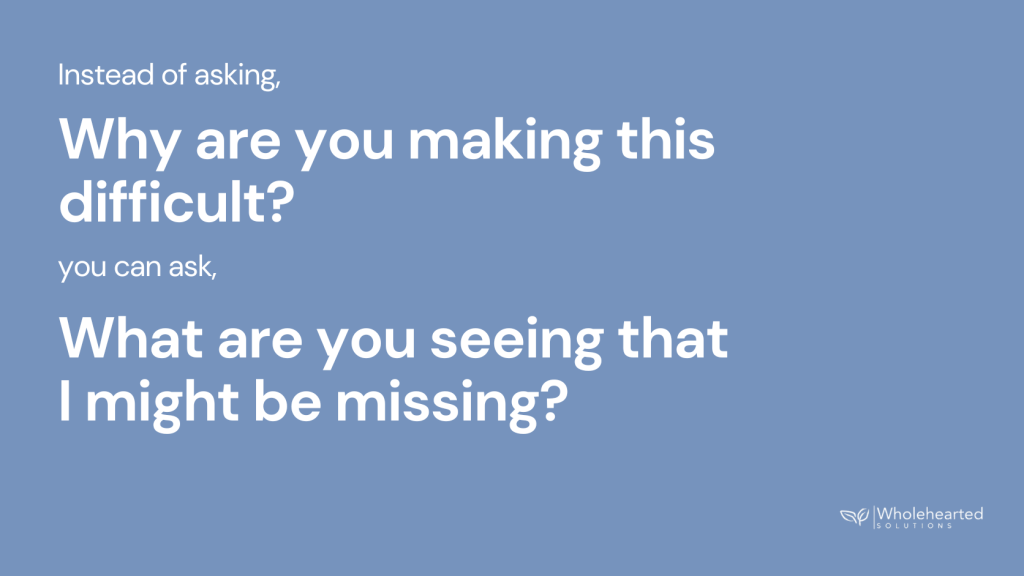
To facilitate true healing, leaders must make three critical shifts: from blame to curiosity, from personalities to patterns, and from symptoms to systems.
The Shadow Side of Stress
When systemic pressure builds and is left unaddressed, the emotional atmosphere of the team changes. Under sustained stress, people stop operating from security. They slip into what we call the “shadow side” of their natural wiring.
When Strengths Become Distorted
Everyone brings natural gifts and contributions to a team. However, when stress narrows our capacity, those exact strengths can become distorted.
A visionary leader who normally inspires possibilities might suddenly become impatient or dismissive.
A careful, detail-oriented strategist might become rigid and controlling.
A highly relational leader might start avoiding necessary, difficult conversations.
These shifts do not happen because people have suddenly become bad colleagues. They are natural stress responses amplified by systemic pressure.
The Shift to Accusation
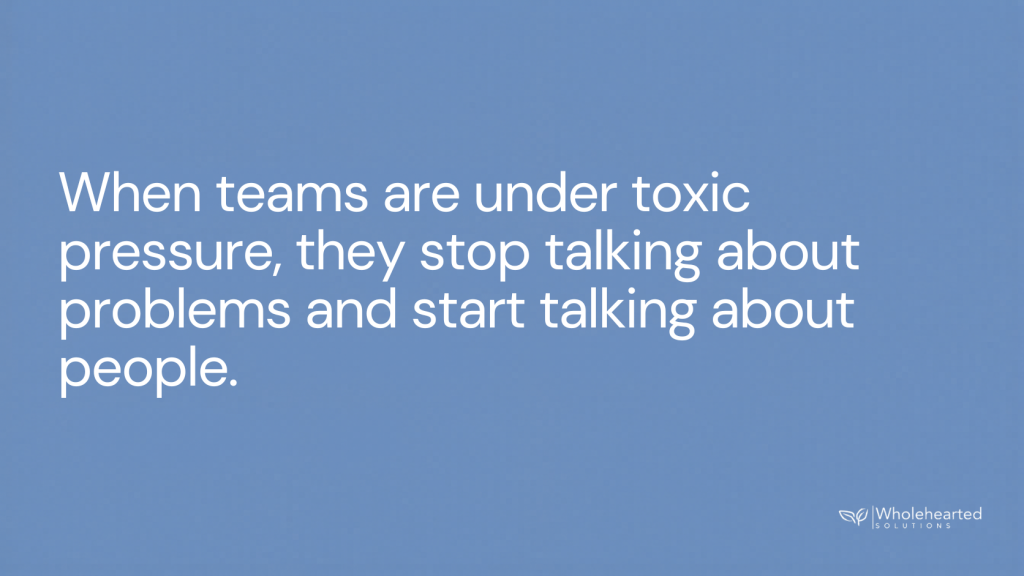
As we often observe, when teams are under sustained pressure, they stop talking about problems and start talking about people.
In this shadow state, curiosity is rapidly replaced by assumption.
Differences that were once valued become perceived as threats.
Meetings turn political, and trust becomes transactional.
People begin assigning negative motives to one another rather than seeking to understand.
Creating a Neutral Third Space: The MPACT Approach
To resolve team conflict effectively, we have to move the conversation away from personal defence and emotional accusations.
One effective way to create this neutral third space is through structured assessment and diagnostic data.
At Wholehearted Solutions, we use the MPACT framework to help teams understand how individuals naturally contribute, communicate, and respond under pressure.
Moving from Opinion to Objective Data
Conflict resolution begins with self-awareness. Before bringing the fractured team together, the process must begin with individual assessment. We spend time with executives one-on-one, helping them understand their own design, patterns, blind spots, and stress responses.
Once we have gathered this individual data, we can analyse the team as a collective whole, identifying systemic gaps, overlaps, and areas of tension.
The Power of the Third Space
When the team finally gathers, they are no longer debating personal opinions. They are looking at external data. This data becomes a shared object of reflection, a neutral “third space”.
Because the diagnostic element introduces neutrality, and celebrates the positive contribution that every team member can bring, defensiveness immediately decreases.
In the end, nobody has to be the villain because everyone has a part to play in the solution. The entire team becomes a student of the system together.
Related: A Guide to Overcoming Leadership Burnout & Flourishing
From Accusation to Attunement: A Real-World Example
To see how this methodology transforms conflict resolution, it helps to look at a classic executive clash: the opportunity-focused Pioneer and the purpose-driven Aligner.
Recognising the Value of Differences
A Pioneer sees opportunity everywhere; their contribution is innovation, generating momentum, and forward movement. They are naturally drawn to possibilities, strategic direction, and helping the organisation achieve its mission.
An Aligner is driven by purpose, meaning, and integrity. They instinctively consider values, consequences, see patterns, risks, and dependencies, helping ensure that progress remains sustainable and aligned with what matters most.
Without self-awareness, the Pioneer may view the Aligner as negative, overly cautious, or resistant to change.
Meanwhile, the Aligner may view the Pioneer as reckless, impulsive, or too focused on results at the expense of purpose and long-term health.
The Shift in Perspective
When we bring them into the neutral third space, they realise they are sharing the exact same mission, just from entirely different perspectives.
The Pioneer is trying to move the organisation forward.
The Aligner is trying to keep the organisation healthy while it moves forward.
Seen through this lens difference is no longer seen as something that divides the team. By moving from accusation to attunement, the team begins to recognise that they are not working against one another but for the same outcome from different vantage points. Their diverse wiring becomes an essential requirement for a healthy outcome.
Empathy increases, tension decreases, and true collaboration expands. What once felt like conflict becomes a source of strength, enabling better decisions, healthier systems, and more sustainable progress. It’s from this place of strength that the systemic challenges can be addressed.
The Leader’s Role
For conflict resolution to truly last, the organisational leader must set the tone. Insight alone is never enough.
We have worked with many leaders who cognitively understand the models and can repeat the language, yet nothing changes.
Why? Because true transformation happens when truth is embodied within the system.
Ownership Over Blame
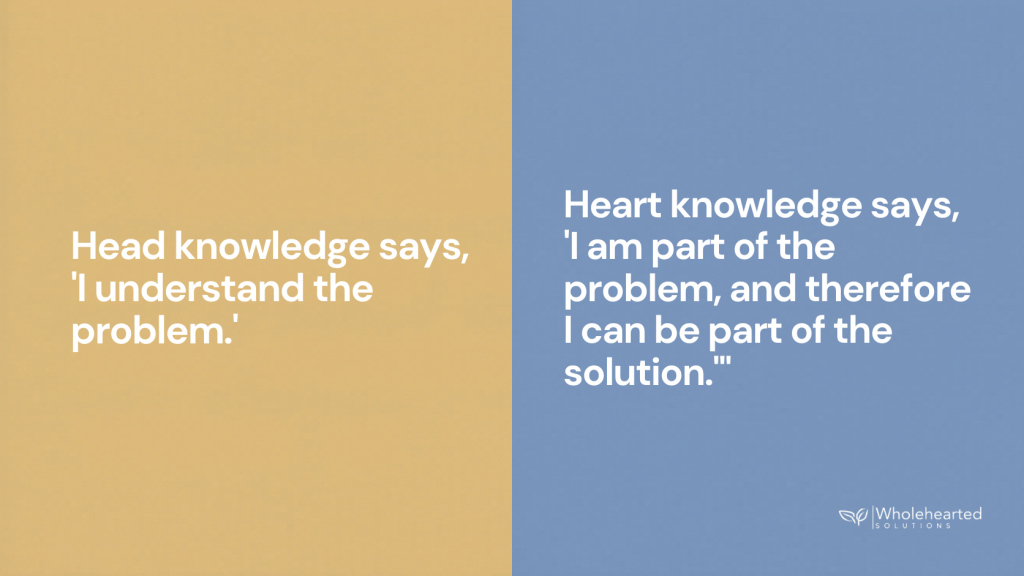
No longer “I understand the problem.” but, “I am part of the problem, and therefore I can be part of the solution.”
Every leader shapes their environment.
Leaders are not outside the system they are trying to improve; they are participants within it. Like everyone else, they respond to uncertainty, pressure, and stress. The difference is that a leader’s behaviour is amplified through the culture around them.
What leaders model, teams often mirror.
If the team culture is dominated by urgency, unclear accountability, or a lack of psychological safety, the leader’s behaviour has likely played a role in reinforcing that reality. This is not about blame. It is about ownership.
The Power of Vulnerability
When a leader becomes vulnerable enough to acknowledge their part in the dynamic, something shifts. Defensiveness decreases across the room. Trust begins to grow. People stop protecting themselves and start participating in the solution. The system relaxes, and the room finally exhales.
What a leader models, the culture multiplies. The healthiest leaders are not the ones who never make mistakes. They are the ones willing to say, “I can see my part. I’m still learning. Let’s grow together.”
That is the exact moment teams stop managing perception and start pursuing transformation.
When leaders choose ownership over blame and attunement over accusation, conflict becomes more than something to resolve. It becomes an opportunity to build deeper trust, healthier systems, and stronger relationships.
Ready to Lead From a Deeper Place?
There is another way to lead: not from pressure, performance, or proving but from a deeper place.
At Wholehearted Solutions, we help leaders and executive teams pay attention to what is happening beneath the surface, so they can build the bridge between head and heart.
If this article has stirred something in you, perhaps the next step is not to push harder, but to pause and explore what wholehearted leadership could look like in your organisation.