
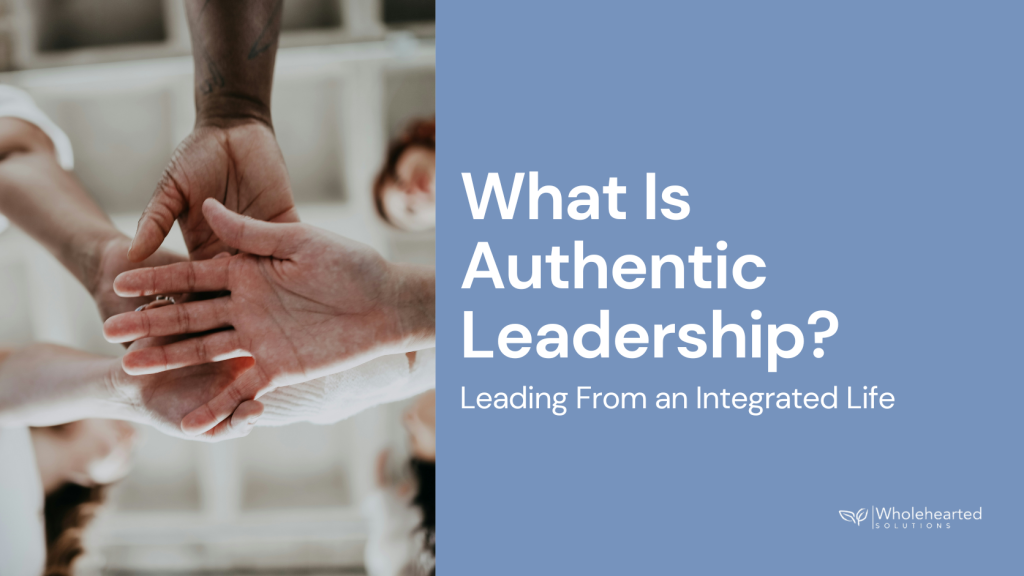
Authentic leadership is often described as being genuine, transparent, or true to yourself.
Those are helpful words.
But they do not quite go far enough.
At Wholehearted Solutions, we would describe authentic leadership as leading from an integrated life
It is the alignment between our inner reality and our outer leadership.
It is the courage to stop performing a role and begin leading from who we truly are.
That does not mean saying everything we feel.
It does not mean abandoning professionalism.
It does not mean removing all boundaries.
Authentic leadership is not radical exposure.
It is congruence.
It is when our values, convictions, strengths, weaknesses, and humanity become integrated rather than compartmentalised.
In other words, it is becoming the same person in every room.
The Problem With the Leadership Mask
Most leaders do not set out to be inauthentic.
They start with hope, vision, responsibility, and a desire to lead well. But over time, many leaders begin to develop a persona.
– The competent leader.
– The visionary leader.
– The strong leader.
– The leader who always has the answer.
– The leader who never seems uncertain.
– The leader who can carry everything.
At first, that persona can feel useful.
It helps us manage how others perceive us.
It protects us from rejection.
It helps us gain acceptance.
It allows us to function in demanding environments.
But the mask always comes with a cost.People can only truly trust the person they meet.
If they encounter a mask, the relationship can only go so far. It may look professional. It may even look successful. But it does not build the depth of trust needed for healthy leadership.
And the cost is not only relational. It is also deeply personal. Maintaining an image is exhausting.
It takes an enormous amount of energy to keep showing up in a way that is different from who you really are. Many leaders reach a point where they become emotionally short of breath, not because they lack skill, but because they are tired of performing.
They are tired of holding the image together, and tired of being strong in public while something different is happening underneath.
The mask may protect us for a while. But eventually, what we use to protect ourselves can begin to imprison us.
Authentic Leadership Is Not Oversharing
One of the reasons leaders hesitate to talk about authenticity is because they confuse vulnerability with exposure.
They hear the word “authentic” and imagine they are now expected to share everything with everyone.
That is not authentic leadership. It is often unwise.
Taking off the mask does not mean removing all boundaries. Healthy leaders still steward privacy, relationships, roles, confidential information, and emotional capacity.
The goal is not to be exposed.
The goal is to be true.
Jesus offers a helpful picture of this. He was fully authentic, but also deeply discerning. There was the crowd, the seventy-two, the twelve, and the inner three. He did not share everything with everyone, but he was never false.
That is the difference.
Authentic leadership is not about making vulnerability a strategy. It is about integrity as a state of being.
It means we are no longer hiding behind an image. We are no longer using performance to cover fear. We are no longer pretending that what is happening inside us has no effect on how we lead.
There will always be things a leader does not share publicly.
But there is a difference between a boundary and a fig leaf.
A boundary protects something important
.A fig leaf hides something unresolved.
A boundary is rooted in wisdom.
A fig leaf is rooted in fear.
A boundary may protect privacy, family, emotional capacity, or confidential information.
A fig leaf hides shame, insecurity, failure, weakness, or need.
One helpful question for leaders is this:
Am I protecting something, or am I hiding something?
That question matters because we can use the language of boundaries to avoid dealing with what is actually happening in us.
There may be things we should not bring into the room. But if anger, anxiety, frustration, resentment, or exhaustion are shaping how we show up, then they cannot simply be ignored.
They may not need to be disclosed to everyone.
But they do need to be dealt with.
Why Leaders Struggle to Be Authentic
The root cause of inauthentic leadership is often not a lack of skill.
It is fear.
– Fear of being exposed.
– Fear of being found lacking.
– Fear that our weaknesses will disqualify us.
– Fear that if people really knew us, they might not respect us.
– Fear that we are not enough.
That fear is ancient.
In Genesis, when Adam and Eve become aware of their vulnerability, their first instinct is not connection. It is concealment. They reach for fig leaves.
Modern leadership often does the same thing.
We may not use literal fig leaves, but we still cover ourselves.
Sometimes fig leaves look like overconfidence.
Sometimes they look like control.
Sometimes they look like busyness.
Sometimes they look like perfectionism.
Sometimes they look like authority, polished language, impressive performance, or relentless achievement.
These masks are not random.
They are protective.They are the ways leaders try to hide what they fear might be seen.
But where we hide, we cannot lead from.
That is the problem.
If we are leading from fear, we tend to become defensive rather than relational.
We manage perception rather than build trust.
We control outcomes rather than create safety.
We perform strength rather than practise honesty.
And over time, that takes a toll.
Not only on the leader, but on the whole team.
Compartmentalised Leadership Creates Fragmentation
The opposite of authentic leadership is compartmentalised leadership.
This is when a leader’s public image does not match their private reality.
They become split into different versions of themselves.
– The work self.
– The home self.
– The stage self.
– The hidden self.
A leader may appear confident in public, while privately feeling deeply insecure.
They may communicate clear vision, while internally feeling confused or uncertain.
They may present strength on a stage, while quietly exhausted behind the scenes.
The issue is not that leaders should be exactly the same in every context. Of course, different rooms require different levels of disclosure and responsibility.
But the deeper question is whether we are integrated.
Is what people see connected to who we are?
Or are we switching identities to survive?
When leaders live compartmentalised lives, fragmentation follows. Internally, there is exhaustion, anxiety, and a loss of identity. Externally, teams begin to sense that something is off.
They may not be able to name it, but they feel the misalignment. They become cautious. They self-edit. They withdraw. Trust begins to thin.
Eventually, the organisation can begin to reflect the inner condition of the leader.
A compartmentalised leader can create a compartmentalised organisation.
Silos grow.
Suspicion increases.
People protect themselves.
Communication weakens.
The team loses its sense of shared flow.
Authentic leadership, by contrast, creates alignment.
And alignment builds trust.
Why Self-Awareness Matters in Leadership
Self-awareness is one of the foundations of authentic leadership.
We cannot lead others well if we do not understand what is driving us.
Every leader has fears, assumptions, motivations, strengths, weaknesses, wounds, and blind spots. Whether we are aware of them or not, they shape our decisions and relationships.
Without self-awareness, those inner dynamics operate unconsciously.
A leader may become defensive without realising why.
They may avoid difficult conversations because something in them fears conflict.
They may seek approval while calling it collaboration.
They may control people while calling it excellence.
They may lead from insecurity while presenting it as conviction.
What is happening internally will eventually show up externally.
We may be able to manage it for a while. But eventually it spills out, or we collapse under the pressure of keeping it hidden.
That is why self-awareness is not a soft leadership extra.
It is essential.
It allows leaders to recognise what is happening beneath the surface so they can respond intentionally rather than react unconsciously.
It creates the foundation for honesty.
Because we can only be honest with others once we have begun to be honest with ourselves.
Authentic Leadership Builds Trust
Trust is the currency of healthy teams.
When there is trust, people are free to contribute. They are free to explore. They are free to stretch. They are free to make mistakes without fearing that failure will be fatal.
But trust is shaped less by strategy and more by emotional tone.
The emotional tone of the leader matters.
When a leader is inauthentic, people become anxious. They become cautious. They choose their words carefully. They hold back parts of themselves because the environment does not feel safe.
But when a leader is authentic, something different happens.
They become a non-anxious presence.
They are able to own weakness.
They can say sorry.
They take responsibility for what is theirs.
They admit uncertainty without collapsing.
They respond to failure with curiosity rather than blame.
Trust is built most deeply in choppy waters.Not when everything is going well.
But when someone makes a mistake.
When the team misses the mark.
When something goes wrong.
When pressure rises.
If a leader moves towards blame and distance, trust falls through the floor.
But if a leader moves towards people with solidarity, understanding, and support, trust grows.This is where the leader’s inner world becomes so important.
If I have not dealt with my own failure, I may become harsh with yours.
If I have not received grace in an area of my life, I may struggle to extend grace to you.
If I am critical of myself, I may become critical of my team.
The way a leader relates to their own inner life often becomes the way they relate to others.
That is why authentic leadership is not only about being honest outwardly.It is about becoming whole inwardly.
How to Become a More Authentic Leader
Authentic leadership does not begin with a new technique.
It begins with attention.
A good first question is:Where am I hiding?
Where am I performing?
Where am I protecting an image?
Where am I afraid of being seen?
Where am I leading from pressure rather than freedom?
Where is my public leadership disconnected from my private reality?
These questions take time.
They require a journey of self-reflection.
One helpful practice is to keep short accounts with your own heart.
After a meeting, conversation, or difficult decision, pause and ask:
What did I feel?
What did I avoid?
Where did I perform?
Where did I hide?
Where was I tempted to protect an image?
What did I bring into the room that I need to deal with?
This is not about self-obsession. It’s about stewardship.
A wholehearted leader pays attention to what is happening within them because they know it will shape what happens around them.
Then comes one step of honest leadership.
Not dramatic exposure.
Just one honest step.
It may be saying:“I do not know yet.”
That can be a powerful sentence.
Many people trust a leader who admits uncertainty more than a leader who pretends to know everything.
It may be asking for genuine input. Not as a box-ticking exercise, but with a real desire to listen.
It may be sharing an honest perspective rather than offering the polished corporate answer.
It may be saying:“I am not sure we have all the answers yet, but let’s move forward together.”
It may be following through on what you said you would do.
That sounds simple.
But in a world where people often say things and do not follow through, consistency becomes deeply refreshing.
Authentic leadership is built through these small acts of integrity.
Not one grand display.
But a thousand small moments where the leader chooses presence over performance.
Authentic Christian Leadership
For Christian leaders, everything we have said comes into even sharper focus.
The principles are not different.
But the stakes are higher.
Christian leadership carries a public and private integration that is difficult to separate. A church leader, ministry leader, or Christian organisational leader cannot simply say, “Now I am at work, and now I am at home.”
Their life, faith, relationships, family, leadership, and character are often held together in public view.
That is why misalignment can be so damaging. If we preach one thing and practise another, there is a deep disconnection.
If our public message and private reality move in opposite directions, trust is not only weakened; it can be shattered.
This is not about perfection.
Christian leadership must always make room for grace, forgiveness, repentance, restoration, and growth.
But it does mean that integrity matters. Truth matters. Wholeness matters
To lead in the name of Christ while hiding behind a false self is spiritually dangerous. It moves us away from the kingdom we are seeking to represent.
Authentic Christian leadership is not about creating a flawless image.
It is about becoming a person without deceit.
A leader whose words carry weight because their life supports them.
A leader who is willing to live honestly before God, themselves, and others.
A leader who is becoming whole.
The Courage to Lead From an Integrated Life
Authentic leadership is not about being casual, unfiltered, or emotionally exposed.
It is about alignment.
It is about integrity.
It is about becoming the same person in every room.
The leader who lives behind a mask may be able to succeed for a while. They may climb. They may impress. They may be celebrated.
But eventually, the mask becomes heavy.
And the team can feel the weight of it.
There is another way to lead.
Not from persona.
Not from fear.
Not from performance.
Not from the exhausting work of maintaining an image.
But from an integrated life. A life at ease with itself.
A place where inner reality and outer leadership begin to align.
A place where presence becomes stronger than performance.
A place where trust can grow because people are finally meeting the real person.
At Wholehearted Solutions, we help leaders, teams, churches, and organisations pay attention to what is happening beneath the surface, so they can lead with greater honesty, health, and freedom.
If this has stirred something in you, perhaps the next step is not to try harder.
Perhaps the next step is to pause and ask:
Where am I hiding?
And what would it look like to lead from a more wholehearted place?