
There is a difference between being tired of work and being burnt out in leadership.
A bored leader may feel disengaged. They may watch the clock, look forward to the weekend, or long for a change of pace. But there is still energy somewhere. There is still life beyond the role.
Leadership burnout is different.
A burnt-out leader is not simply lacking motivation. They are running low on inner capacity.
The work still gets done.
The meetings still happen.
The decisions still get made.
But underneath, something is becoming thin.
Many senior leaders, CEOs, founders, church leaders, and executives keep functioning long after they have stopped flourishing. From the outside, they still look capable. They are composed in the boardroom, clear in conversation, and able to carry responsibility.
But inside, the experience is different.
They may be waking up tired, even after rest.
Losing patience faster than they used to.
Carrying a low-level tension that never quite switches off.
Feeling emotionally distant from the people they are leading.
Finding that the things they once enjoyed now feel like another demand.
This is often one of the clearest signs of leadership burnout: life begins to feel heavy, not only work.
You can still be succeeding in public and feel short of breath in your soul.
For many leaders, this creates a painful gap between the head and the heart.
The head knows what needs to be done.
The heart no longer has the strength to carry it in the same way.
Over time, this can lead to emotional fatigue, quiet cynicism, isolation, and a deep sense of disconnection. Not always dramatic. Not always visible. But real.
And because leaders are often trained to keep going, they learn to cover it well.
They develop protective patterns. These patterns may help them survive for a while, but they do not lead to wholeness.
Some leaders work harder, believing the next breakthrough, promotion, project, or achievement will finally settle what is happening inside.
Some check out, staying present physically while slowly withdrawing emotionally.
Some numb or distract themselves with noise, busyness, scrolling, alcohol, overwork, or anything that helps them avoid what is happening beneath the surface.
Some control more tightly, gripping the external world because their internal world feels uncertain.
These are not simply bad habits. Often, they are ways of coping.
But what we use to protect ourselves can eventually begin to imprison us.
Leadership burnout is not always a failure of strength. Sometimes it is the heart asking to be heard.
Everything Flows From the Heart
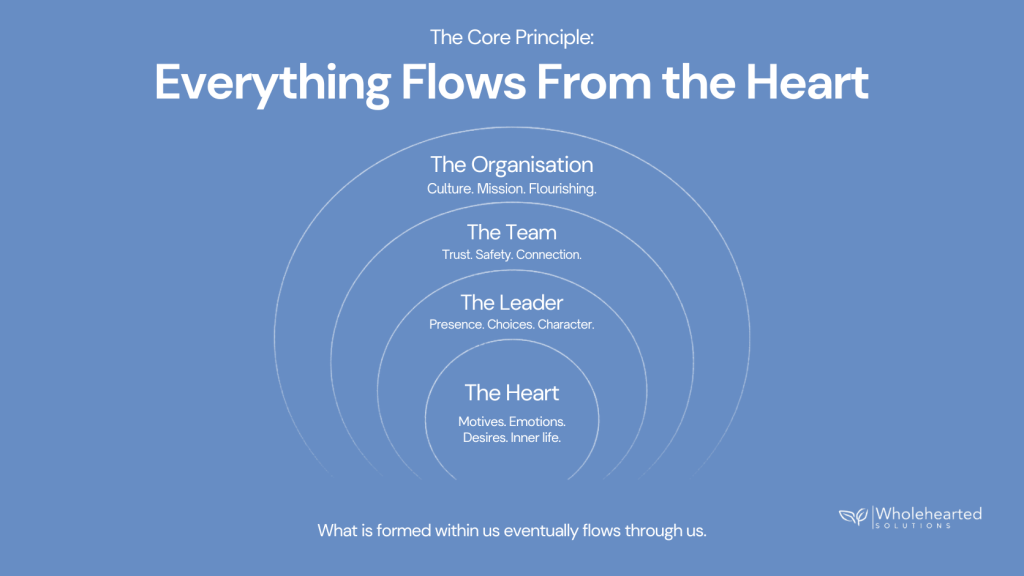
If leadership is to be restored, we have to return to a simple truth:
Everything flows from the heart.
Even in the boardroom.
Even in strategy meetings.
Even in organisational culture.
Even in the way a leader responds under pressure.
In leadership, we often measure what is visible.
Performance.
Delivery.
Growth.
Decision-making.
Team output.
Organisational results.
These things matter. But they are not the whole story.
At Wholehearted Solutions, we believe that what is happening above the surface is always connected to what is happening beneath it. Behaviour has an origin. Culture has a source. Leadership has a heartbeat.
This is why overcoming leadership burnout requires more than better time management, more sleep, or a few improved habits.
Those things may help. But they cannot heal what they do not reach.
A leader may change their diary and still be driven by fear.
They may improve their routines and still be carrying shame.
They may take time off and still return to the same hidden patterns.
Real restoration has to go deeper.
It means paying attention to the inner life of the leader: the fears, beliefs, wounds, motivations, and long-held patterns that quietly shape how they lead.
This is the work of rebuilding foundations.
The picture we often return to is the ancient vision of becoming like a well-watered garden: rooted, restored, connected, and alive from the inside out.
This is not simply a spiritual idea. It is also deeply practical.
Modern neuroscience continues to show us how much our emotional world shapes our behaviour, reactions, relationships, and capacity for regulation. Scripture has always spoken about the heart as the place from which life flows.
Science and ancient wisdom meet here.
To lead well, we must learn to listen beneath behaviour.
Because every leader carries an inner emotional world. And every organisation, in some way, begins to reflect it.
The private world of a leader eventually becomes the atmosphere of the team.
This is what we mean by the cultural heartbeat of an organisation.
When a leader is anxious, depleted, defensive, or disconnected, the team feels it. They may not be able to name it, but they adapt to it. Some withdraw. Some over-function. Some comply. Some become afraid to speak honestly.
But when a leader becomes more whole, the atmosphere begins to change.
A healthier inner life creates healthier leadership.
Healthier leadership creates safer teams.
Safer teams create stronger organisations.
The goal is not just performance.
It is wholeness.
The Path Back: Reveal → Shift → Cultivate
Leadership burnout rarely changes through a quick fix.
Real change is intentional. It is a journey of becoming whole again.
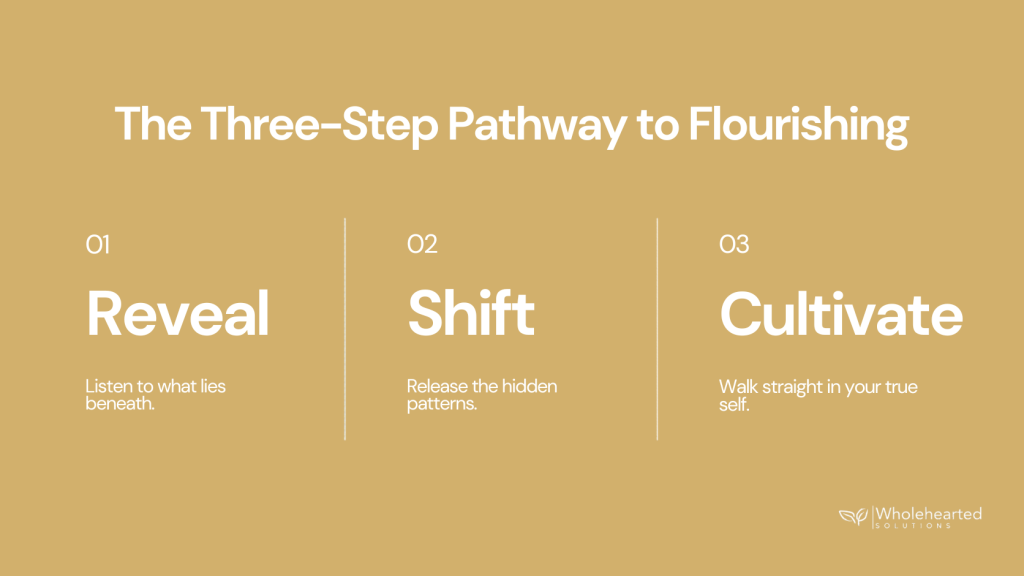
At Wholehearted Solutions, we often describe this journey in three movements:
Reveal → Shift → Cultivate.
From awareness, to freedom, to formation.
1. Reveal: Listen to What Lies Beneath
The starting point is honesty.
Leadership is noisy. Fast. Demanding. There are always people to respond to, decisions to make, problems to solve, and responsibilities to carry.
In that pace, it is easy to lose touch with what is really happening inside.
Reveal is about slowing down long enough to listen.
It is like stepping out of a busy city into the quiet. At first, it may feel still. But as you pay attention, you begin to hear what was always there. The distant sounds. The movement in the background. The things that were hidden by the noise.
Silence does not create what is inside us. It reveals it.
For a leader, this may mean noticing exhaustion that has been ignored for too long. It may mean naming anxiety, resentment, grief, fear, or disappointment. It may mean admitting that the way you are leading is no longer sustainable.
This is not about shame.
It is about truth.
Because what remains hidden often keeps leading us.
A leader cannot shift what they have not first been willing to name.
2. Shift: Release the Patterns Beneath the Behaviour
What is revealed can be transformed.
Shift is about recognising the deeper patterns that have been shaping your leadership from beneath the surface.
For many leaders, this includes fear of failure, imposter thinking, old narratives, unresolved pain, or the belief that they must always be strong, always be useful, always be in control.
These patterns often began as protection.
But over time, they become prisons.
A leader may think they are simply being diligent, when underneath they are being driven by fear.
They may think they are protecting excellence, when underneath they are avoiding vulnerability.
They may think they are carrying responsibility, when underneath they are carrying shame.
This is why leadership burnout cannot only be addressed at the level of behaviour.
The deeper question is not only, “What am I doing?”
It is also, “What is driving me?”
The patterns we do not name are the patterns that lead us.
For Christian leaders, this is where surrender becomes real. Not as a vague spiritual phrase, but as an honest movement of the heart.
Naming what is being carried.
Bringing it into the light.
Entrusting it to Jesus.
Allowing grace and truth to reshape what has been driving from beneath the surface.
This is the work of unhooking.
So the past no longer defines the present.
So fear no longer has to lead.
So the leader can begin to respond from freedom rather than survival.
3. Cultivate: Learn to Walk Whole Again
Healing is not just release. It is formation.
When a long-held weight is lifted, the body can still remain bent. It takes time and intention to stand upright again.
Leadership is similar.
Even after a leader has named what is underneath and begun to release old patterns, they still need to cultivate a new way of living and leading.
This is where healthy leadership becomes practice.
Cultivate is about building new patterns that are integrated, sustainable, and true.
For leaders, this may look like creating healthier rhythms. Becoming more honest about limits. Learning to lead without fear. Building psychological safety in the team. Modelling emotional health rather than emotional avoidance.
It also means aligning who you are with how you lead.
No longer split between the public leader and the private person.
No longer performing strength while quietly running empty.
No longer leading from pressure, proving, or self-protection.
Instead, learning to lead from the true self.
Whole. Present. Grounded. Free.
Healing is not only laying the burden down.
It is learning how to walk differently afterwards.
From Inner Life to Organisational Culture
Leadership is never neutral.
The inner life of a leader affects the emotional tone of the people they lead.
An anxious leader can create an anxious team.
A defensive leader can create a guarded culture.
A depleted leader can unintentionally teach others that exhaustion is normal.
A leader who is always proving can create a team that feels it must prove itself too.
People often feel the emotional atmosphere of leadership before they can explain it.
This is why the health of a leader matters so deeply.
Not just for the leader, but for the organisation.
When a leader tends to their inner life, they become less reactive and more present. They are able to listen without defensiveness. Respond without panic. Make decisions without being driven by hidden fear.
They become what many teams deeply need: a non-anxious presence.
And that presence changes the room.
It lowers fear.
It restores trust.
It creates space for honesty.
It allows people to bring more of themselves to the work.
This is how culture begins to shift.
Not only through new policies, values, or away days, but through the health of the people carrying leadership responsibility.
Culture shifts because the source shifts.
A Final Reflection
Pause for a moment.
When did you last feel real joy?
Do you still have energy for the things you love?
Are you leading from a place of freedom, or from pressure?
Are you becoming more whole as you lead, or slowly less yourself?
Leadership burnout is not always loud. Sometimes it is quiet. It shows up in the places where joy has faded, patience has thinned, and the heart has grown tired.
But there is another way to lead.
Not from pressure.
Not from performance.
Not from proving.
But from a deeper place.
Your leadership will always flow from your inner life.
So the real question is not only how high you can climb.
True success is not climbing higher while becoming less whole.
It is becoming whole as you lead.
If this article has stirred something in you, perhaps the next step is not to push harder.
There Is Another Way to Lead
There is another way to lead: not from pressure, performance, or proving — but from a deeper place.
At Wholehearted Solutions, we help leaders, teams, churches, and organisations pay attention to what is happening beneath the surface, so they can build the bridge between head and heart and lead with greater health, clarity, and freedom. If this article has stirred something in you, perhaps the next step is not to push harder, but to pause and explore what wholehearted leadership could look like in your life and leadership.