
When pastors hear the phrase “leadership coaching,” the mind often jumps straight to logistics.
We think of church growth strategies, attendance metrics, team dynamics or change management. We look for the latest tactics to handle the endless demands of ministry.
But true coaching for church leaders requires a massive paradigm shift.
It isn’t just about what a leader does, it is fundamentally about who a leader is.
So, what exactly does leadership coaching look like through a Wholehearted lens, and why is it absolutely critical for the health of the church?
What Is Leadership Coaching for Pastors, Really?
Pastors are constantly surrounded by advice. Congregations, podcasts, and books endlessly offer opinions on what a leader should do, focusing almost exclusively on external behavioural tweaks. But Wholehearted coaching operates on an entirely different wavelength.
To understand how wholehearted coaching differs from standard leadership advice, it helps to explore three key concepts:
The Surgeon . Not The Tools
Think of leadership like walking into an operating room. If you are about to undergo surgery, you aren’t primarily concerned with the brand of scalpel the doctor uses. You are deeply invested in the health, focus, and expertise of the surgeon holding it.
Wholehearted Leadership coaching focuses on the surgeon, not the tools.
While leadership tactics are important, focusing solely on them misses the most critical element: the leader themselves.
A church can have all the right strategies, but sustainable leadership ultimately flows from who the leader is and how they show up.
Advice Speeds You Up; Coaching Slows You Down
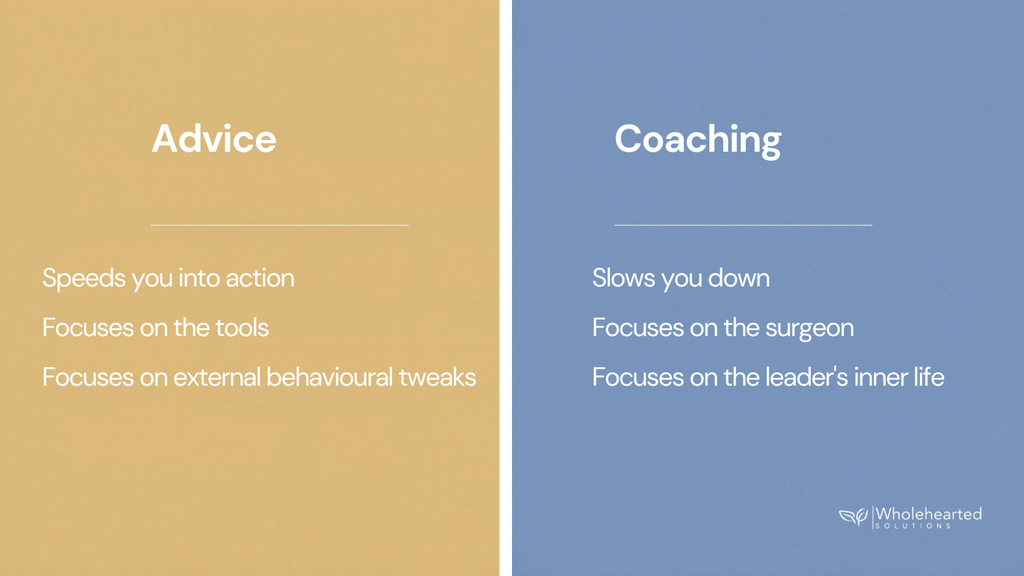
There is a profound difference between giving a pastor advice and coaching them.
Coaching creates a psychologically safe, non-judgmental environment where a pastor doesn’t have to perform or have all the right answers.
It isn’t about prescribing quick fixes; it is a journey of self-discovery.
The “Reveal, Shift, Cultivate” Framework
Rather than simply landscaping a leader’s life to make the surface (the image) look beautiful, true coaching excavates the heart. This involves a distinct three-part journey:
- Reveal: Moving from hiding to honesty. It is about identifying the underlying fears, shame, guilt, or disappointments that are secretly driving a leader’s reactions.
- Shift: Processing and healing those internal blockages so the leader is no longer held hostage by them.
- Cultivate: Building a sustainable lifestyle that keeps the “stream of the heart” clear over the long haul.
The Hidden Cost of Leading on Empty
Most leadership roles in the corporate or non-profit sectors are boundaried. Pastors, however, lead with virtually no frame. They are deeply embedded in the entirety of their congregation’s lives, the extreme highs, the devastating lows, and everything in between. Because of this pastoral ministry carries a unique, heavy weight.
Let’s explore the often hidden emotional toll and the warning signs that indicate it’s time to pause:
1. Carrying Other People’s Pain
Pastors are invited into the most painful chapters of people’s lives. They sit with families after devastating diagnoses, walk alongside marriages that are falling apart, and stand at gravesides helping others process grief.
Week after week they absorb stories of loss, trauma, addiction, disappointment and despair. While it is a privilege to be trusted with these moments, carrying so much pain for so many people takes a significant emotional toll.
Over time, the weight of constantly entering other people’s suffering begins to accumulate. Even when they appear strong and composed, pastors often carry the emotional residue of countless difficult conversations.
They learn to keep going, to be present for the next crisis, and to put the needs of others first. Yet beneath the surface they can become exhausted, depleted and overwhelmed by a burden that few people ever see.
Most pastors carry a deep sense of responsibility for the people they lead. They are constantly thinking about individuals who are struggling, drifting from faith, facing challenges at home, or wrestling with important decisions.
2. Constant Responsibility for People
Even when they are off duty, their minds rarely switch off because the needs of the church remain close to their hearts.
This responsibility can become especially heavy when people make choices that harm themselves or others. Pastors know they cannot control outcomes, yet they often feel a personal burden for situations they could never fully prevent or resolve.
Over time they can begin carrying responsibilities that were never meant to rest on one person’s shoulders, creating a persistent sense of pressure that is difficult to escape.
3. Loneliness and Isolation
Leadership can be an unexpectedly lonely place. While pastors may be surrounded by people every day, there are often very few relationships where they feel completely safe to share their fears, doubts and struggles. The very role that connects them to so many people can make genuine vulnerability feel risky.
As a result, many pastors find themselves carrying significant burdens alone. They become accustomed to being the one who listens rather than the one who is listened to. They support others through difficult seasons while quietly navigating their own.
Over time this isolation can create a deep sense of loneliness, leaving leaders feeling unseen and unsupported despite being constantly surrounded by community.
4. Criticism and Unmet Expectations
Few roles carry as many competing expectations as that of a pastor. People expect them to be spiritually mature, emotionally available, visionary leaders, gifted communicators, wise counsellors and devoted family members all at the same time. Yet no matter how hard they work, someone is often disappointed that they are not doing more.
Over time, criticism can become one of the heaviest emotional burdens of ministry. Decisions are questioned, motives are misunderstood, and mistakes are remembered long after successes are forgotten.
Even constructive feedback can be draining when it is constant. Many pastors learn to smile, remain gracious and keep moving forward, but repeated criticism can gradually erode confidence and leave deep emotional wounds that are rarely acknowledged.
5. Betrayal Trauma
Because of this boundary-less environment, pastoral ministry carries a unique, heavy weight. Pastors invest years discipling, loving, and leading individuals, only to sometimes have those same people leave the church over minor disagreements, barely looking back. People leave without notice or explanation.
This accumulation of “betrayal trauma” often leaves leaders feeling profoundly isolated. Over time, to survive the pressure, pastors learn to hide.
They learn to distrust new relationships, get comfortable with keeping a distance and in a bid for self protection lock away the ways they have been hurt because the “show” must go on.
They build a “perfect pastor” image and eventually begin to believe their own press release, becoming entirely disconnected from their own internal reality.
The Warning Signs of Burnout
Because the erosion of a leader’s inner life happens slowly, it rarely looks like an immediate moral failure or blowout. Instead, pastors keep pushing through, adapting to the dysfunction. It shows up in subtle, dangerous shifts:
- The Loss of Joy: This is the ultimate early warning sign. Before the church notices anything, a pastor’s spouse and children will see that the quiet joy for life and ministry has been extinguished.
- Emotional Tiredness: This isn’t physical exhaustion; it is a profound lack of emotional capacity. The leader moves from a pioneering, visionary mindset to mere survival and maintenance mode.
- Decision Fatigue: When running on empty, even small, routine choices start to feel overwhelmingly heavy.
- Relational Withdrawal: A depleted leader becomes reactive rather than responsive. Conflict feels monumental, vulnerability feels too risky, and the pastor becomes guarded and distant.
The Relief (and Grief) of Honesty
When a pastor finally steps into a coaching environment and drops the performative mask, two things happen.
First, there is immense relief. They realize they are no longer carrying the weight alone.
Second, there is often grief. Once they slow down, they see the high cost of how they have been living the tiredness they ignored and the disconnection they normalized.
But that honesty is the exact catalyst needed for lasting transformation.
The Ripple Effect on Church Culture
Why does pastoral coaching matter beyond the individual?
Because a healthy church culture is inextricably linked to the health of its leader.
A pastor does not just build culture through organizational systems; they shape it through who they are and how they show up.
Becoming a Non-Anxious Presence
When a pastor is exhausted or insecure, they often become an anxious leader who tightly controls the environment. In a controlled environment, people are terrified to fail, which suffocates growth.
However, when a pastor is at peace and secure in their inner life, they transform into a non-anxious presence. A grounded, self-aware leader is secure enough in their own identity to let their team try, fail, and learn.
This internal shift creates a massive external ripple effect:
- Teams become highly collaborative.
- Conflict is handled constructively rather than avoided.
- The church culture shifts from performative and fear-based to a place of trust, grace, and authenticity.
- Discipleship thrives, because true discipleship is, at its core, a coaching culture.
When Is It Time to Seek Support?
Leadership coaching isn’t a crisis intervention meant only for when a pastor hits a wall or faces burnout; it should be an essential, proactive way of life. Unfortunately, because of tight church budgets and a culture that tells pastors they should “handle it,” many wait far too long.
If you are wondering whether it is time to seek a third space for external support, start by asking yourself these penetrating questions:
- When was the last time I truly loved my job?
- Am I excited about next year in my church, or just surviving this one?
- Is my family thrilled with the work I am doing, or are they paying the price for my exhaustion?
If the answers are followed by a long, heavy silence, it is time to stop pushing through.
Sustainable leadership doesn’t emerge from having all the answers; it flows from a leader who is at ease with themselves, secure in their calling, and leading from a whole heart.