
There is a profound difference between managing an organisation and genuinely leading its people.
When executives first seek support, they often carry a heavy, metrics-driven standard of success. From the outside, they look composed. They cast the vision, make the hard calls, and deliver the required results. But behind closed doors, the experience is frequently one of quiet exhaustion and relentless pressure.
If you are navigating a crisis or feeling stretched beneath the surface, you might find yourself searching for the true definition of a good leader. The corporate world might tell you it is strictly about performance, KPIs, and market dominance.
But through the Wholehearted lens, we often find something completely different. Leadership is not found in a quarterly report.
It is an inside-out process. If you want to build a resilient culture, you have to look beneath the surface behaviour and address the inner life of the leader.
The Myth of the Metrics-Driven Leader
Before we can heal a fractured team dynamic or overcome executive burnout, we have to rethink how we measure success.
As organisations grow, ambition often outpaces the structures designed to support it. Leaders try to manage this tension by gripping tighter to operational metrics.
While results are undeniably important, they are not the only metric of success. When we define executive influence purely by numbers, we encourage leaders to operate in a compartmentalised way separating who they are from how they lead. This division is what makes leadership fragile.
At its core, what is leadership and what makes a good leader?
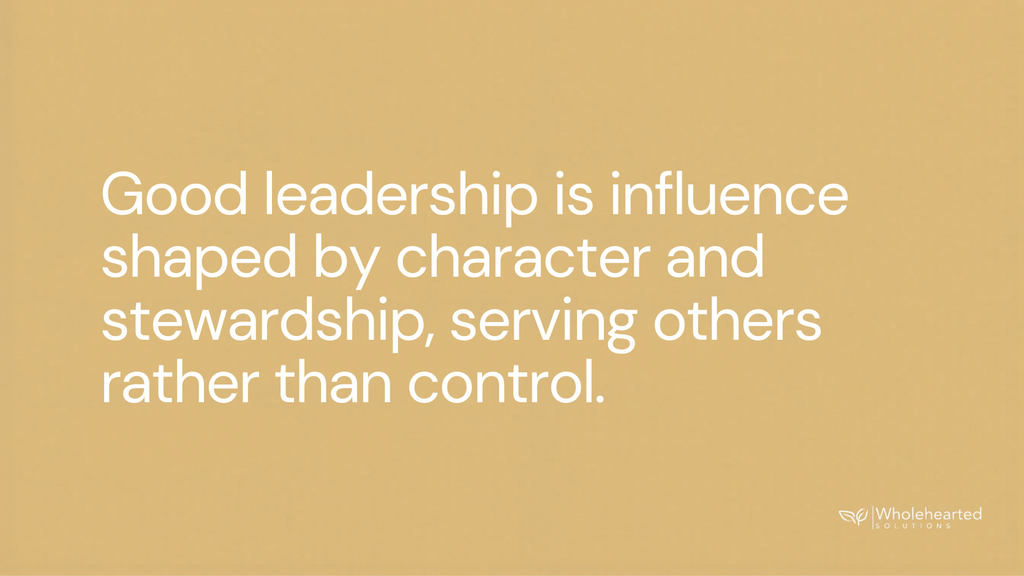
True authority is never simply given by a corner office or a job title. Authority is something that must be faithfully stewarded. It is rooted deeply in your authentic identity and uncompromising integrity.
When teams are under sustained pressure, they stop following a title and start following a person they trust. True influence is built on serving others, rather than attempting to control them.
Diagnosing the Mechanics: Looking Below the Surface
If we want to build healthier cultures, we must be able to identify the metrics of healthy stewardship. So, what characteristics make a good leader when the pressure is on?
It is tempting to look for surface-level charisma or rapid decision-making. But lasting leadership requires a different set of metrics. We look for specific, deeply ingrained traits:
-Empathy and a willingness to connect.
-Humility to acknowledge you do not have all the answers.
-Consistency that builds psychological safety.
-Emotional intelligence and relational trust.
But how do you systematically diagnose whether these traits are genuine or merely lip service?
You look at the organisational systems and you listen to the stories the employees tell. When systemic pressure builds and is left unaddressed, people slip into the shadow side of their natural wiring. Strengths become distorted.
A visionary becomes dismissive; a strategist becomes rigid. Genuine leadership characteristics are proven not by what a leader says on stage, but by how the system reacts and functions when that leader enters the room.
Creating Space for True Healing
The very first step in untangling team dynamics is not to rush in with a quick fix. It is to hold space and listen. People change when they feel understood, not when they feel analysed.
To facilitate true healing within a stretched team, leaders must change how they approach the tension. They must make three critical shifts in their leadership posture:
Move from blame to curiosity.
Move from personalities to patterns.
Move from symptoms to systems.
When you hold this kind of neutral space, defensiveness immediately decreases. The team stops managing perception, stops looking for a villain, and starts participating in the solution.
The Head-to-Heart Shift: Moving from Information to Integration
Many high-performing executives logically understand the best attributes of a leader at a cognitive level. They can read the models, recite the frameworks, and say the right things in the boardroom.
Yet, nothing changes. The culture remains stuck.
Why? Because leaders rarely lack information; what they lack is integration. Bridging the massive gap between intellectual knowledge and authentic embodiment requires moving out of a defensive posture.
It requires deep self-awareness, total acceptance, and an alignment of your values with your daily practice.
To resolve this, we often create a neutral third space using diagnostic tools like the MPACT framework. When leaders stop debating personal opinions and start looking at objective data, defensiveness decreases.
This is the exact moment truth moves from the head to the heart. This is when leaders stop managing perception and start pursuing transformation.
The Courage to Surrender Control
Even after a leader has named what is underneath and begun to release old patterns, they still need to cultivate a new way of living. Healing is not only laying the burden down; it is learning how to walk differently afterwards.
This means actively aligning who you are with how you lead. It requires living in a fully integrated space where you are:
No longer split between the public leader and the private person.
No longer performing strength while quietly running empty.
No longer leading from pressure, proving, or self-protection.
Instead, you learn to lead from your true self. Whole. Present. Grounded. Free.
To achieve this level of integration, what qualities make a good leader stand out? The answer lies in radical vulnerability. True authority requires something entirely counter-intuitive: surrendering control.
We understand that this is a terrifying prospect for most high-achieving executives. When our internal world feels uncertain, we are instinctively trained to grip the external world even tighter. But letting go of the need to manage every outcome demands a new set of inner resources:
-Deep humility to accept your limitations and rely on others.
-The courage to step into the unknown without a guaranteed safety net.
-The faith to trust the process and empower your team.
Only by releasing these hidden fears can you truly embrace executive influence as a dedicated, wholehearted act of service.
The Ultimate Transformation: Measuring Your True Legacy
Ultimately, when the revenue numbers fade, the products evolve, and all that is left is your legacy—what makes an effective leader in the eyes of the people they served?
True leadership is not measured by the success of a product. It is measured by the flourishing of people. A good leader is remembered for making others feel seen, valued, and more fully themselves in their presence.
When you look back at your time in leadership, your legacy will be defined by three critical measures:
-Did your people flourish and become healthier or more courageous?
-Did you remain authentic and whole?
-Did you steward your influence faithfully?
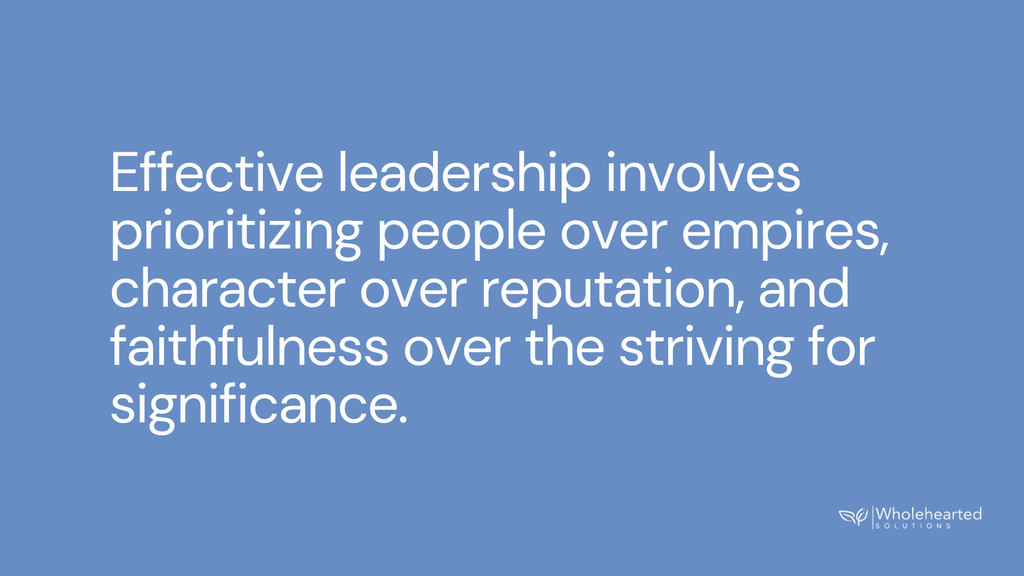
Prioritise people over empires.
Prioritise character over reputation.
Prioritise faithfulness over the endless striving for significance.
Ready to Lead From a Deeper Place?
There is another way to lead: not from pressure, performance, or proving but from a deeper place.
At Wholehearted Solutions, we help leaders, executive teams, and organisations pay attention to what is happening beneath the surface, so they can build the bridge between head and heart.
Whether through executive coaching, team culture mapping, or tailored leadership retreats, our goal is to cultivate transformed people and healthier relationships based on integrity, service, and courage.
If this article has stirred something in you, perhaps the next step is not to push harder, but to pause and explore what wholehearted leadership could look like in your organisation.